
I have one simple ask before you read on. I’ve been nominated for the Thinkers360 Annual Awards and voting is open now. Click the image above to sign up using your LinkedIn account and vote in under 2 minutes. Step by step voting instructions are at the bottom of this post. I’d be genuinely grateful for your support. Thank you.
In a workshop I teach called Strategies for Life Success, I ask participants to do two things: write down the things you are exceptional at, then write down the things you love doing. The exercise sounds simple, and what comes out of it rarely is.
I taught it recently to a group of professionals in the financial industry. When I asked people to share what they had written, one participant said she was exceptional as a food critic and travel advisor, and she spoke about both with enthusiasm.
I pointed out, gently, that she was currently working in finance and doing neither of those things.
She looked down at the paper, up at me, and then shrugged her shoulders and said, “for now.” In that moment, she understood that the career she was building had nothing to do with the life she actually wanted to create. She is not the only person to have had that realization. Unfortunately, I see this all the time.
I also coach an executive who has been unhappy in his work for years and has never felt any connection to the industry he is in. When I asked why he stayed, he said he felt trapped. I asked him to try something different. Imagine, I said, that you are your own best friend, sitting across from yourself. What advice would you give?
He did not hesitate. Saying he would tell himself to leave and that several of his family and friends had already said the same. He had known the answer for a long time.
Contrast those two people with others I see in the same workshop. Some participants describe their work with unmistakable joy. They cannot believe they get paid to do what they do. Their excitement and passion are obvious.
I am one of those people. I cannot imagine doing anything other than what I do: studying ideas about leadership and business, thinking through how they apply to the organizations and people I work with, and sharing those ideas in ways that help someone build a better company, career, or life. This is the work I was built for, and the success that has followed flows directly from that alignment.
What Jim Collins Discovered
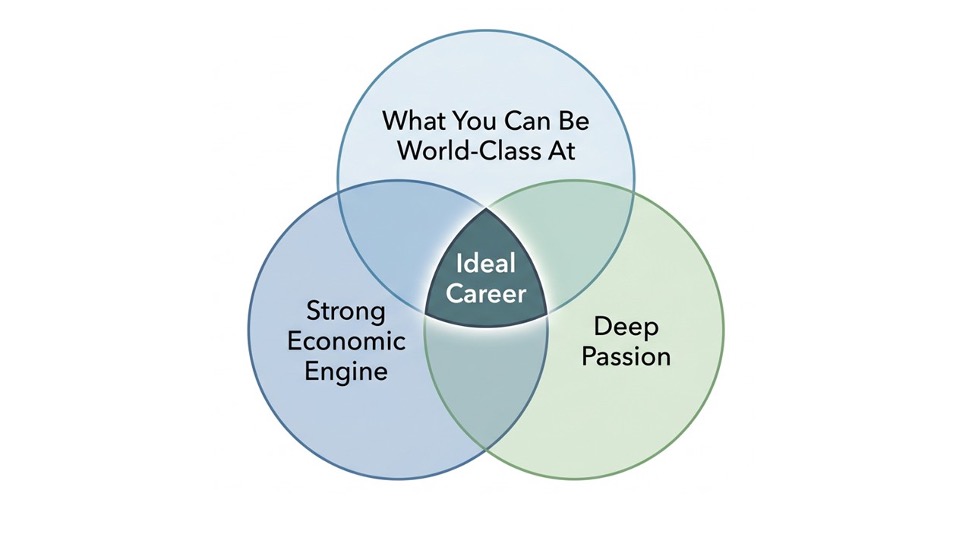
Jim Collins, in his book Good to Great, identified a clear pattern among world-class organizations. The companies that achieved sustained, extraordinary results had developed deep clarity about three things: what they could be world-class at, what they were deeply passionate about, and what drove their economic engine. The companies that broke through focused with discipline on the place where all three answers converged. The same framework applies directly to your career.
The Four Outcomes
If you are skilled at something and the market pays you well for it, but you feel no connection to the work, you have a job. Many people have very good jobs. There is just no excitement in them, no sense of satisfaction. They are waiting for the weekend and counting the years to retirement.
If you love something and have developed real skill in it, but the market will not pay you for it, you have a hobby. Hobbies are great and important, but they do not cover the mortgage.
If you love something and the market will pay for it, but you have not developed the skill to deliver it with genuine excellence, you are on a fragile path. I will address this below.
When all three converge and you are doing work you can become world-class at, that you deeply enjoy, and that the market rewards, you have found your ideal career. That is the only combination that is both sustainable and fulfilling. This is where you should focus.
Good Is the Starting Point, Not the Destination
One nuance here is worth addressing. What if you are passionate about something, the market will pay for it, yet you are good at it but not exceptional? This is not a problem. It is a signal.
Being good at something you love that the market values means you have found your lane. The work now is to become world-class, and that is entirely achievable if you commit to it. This means a serious, sustained effort at learning about the topic, deliberate practice over years, and finding mentors and coaches who can compress your development curve. The gap between good and excellent is the most important project you will take on, and the earlier you start, the more you compound your learning. Delay pushes your dreams further away. Urgency creates momentum.
You Are a Business
In the career portion of the workshop, I introduce a concept I call You Inc. Think of yourself as a small company whose product is everything you bring to your work: your skills, your experience, your judgment, and your expertise. Your employer or your clients are the customer, and the marketplace decides, based on the quality and distinctiveness of what you offer, whether it is valuable enough to pay for at a level that supports the life you want to build. Many people have never thought about themselves this way, and it changes how they make every professional decision afterward.
The Four Criteria for a Sustainable Career
After years of working with organizations on strategy, I have condensed what I know into a simple formula:
Effective Strategy = Valued Differentiation × Disciplined Execution
The same formula I use with organizations applies directly to your career. Let’s take a moment to understand how it applies to You Inc.
Valued differentiation means what you offer is:
- Unique and compelling
- Highly valued by the people you serve
- Difficult or impossible to copy
- Consistently executed with excellence
Unique and compelling means what you bring to the market stands out in an interesting and uncommon way.
This ties directly into the second element: it must also be highly valued by the people you serve, so that they are willing to pay any reasonable price you request. I could stand on the corner dressed as a clown, juggle, make balloon animals, and hand out free hotdogs. That is unique, but it is not why someone would hire me to help their company with strategy.
Next, what makes you valuable must be difficult, or impossible, to copy. What you have built through years of focused experience, the particular combination of knowledge, perspective, and skill you bring, the way you think through problems and deliver results, these are things that cannot simply be picked up by someone who decides to compete with you. The more distinctive and deeply developed your expertise, the harder you are to replicate and the stronger your position becomes.
Finally, you must be able to deliver consistently with excellence. The people you serve need to experience your value every time they interact with you. Differentiation means nothing if you cannot back it up in the real world, every time.
The Cost of Waiting
Nothing about your situation changes until you change something about it. The career you have today is the direct result of the decisions you have made up to now, and the career you have in ten years will be the direct result of the decisions you make starting today.
The longer you remain in a career that does not align with the work you were built to do, the harder it becomes to leave. Financial obligations grow, identity attaches to the role you hold, and the willingness to take risks declines. The executive I described earlier knows what he should do, and the longer he waits, the narrower his options become.
I am not suggesting you walk in and resign tomorrow. What I am asking you to do is make an honest decision: acknowledge that where you are is not taking you where you want to go, and commit to beginning the process of moving in the right direction. That process starts with the exercise below.
The Exercise
Answer the Collins questions honestly. What can you be world-class at, that you are deeply passionate about, and that people are happy to pay for?
Then apply the four criteria to whatever sits at that intersection. Is it unique and compelling? Does the market value it highly? Is it difficult to replicate? Can you deliver it with consistent excellence?
If your current work sits at the center of both frameworks, you have found your lane. Build there, develop your skills relentlessly, and the results will follow.
If there is a clear gap between where you are and where those circles actually overlap, that gap is not a nuisance or a distraction. It is a signal your work is sending you, and it is asking you to do something about it.
The Life You Have Left to Build
I have taught Strategies for Life Success to executives around the world. The questions it raises apply to anyone willing to take them seriously.
The people who do this work and follow where it points them find clarity they did not know they were missing. They are doing what they were built to do, and the difference is visible in their energy and the arc of their careers over time.
The people who recognize the gap and do nothing carry something heavier.
Spending years, or decades, in a career that has no connection to the work you were built to do is soul crushing. I see this regularly in people who live with regret. They look back and realize they have wasted their most precious resource, their limited time, trudging through a career that gives them no joy.
Jeff Bezos, in his final shareholder letter as CEO of Amazon, put it this way.
“I know a happily married couple who have a running joke in their relationship. Not infrequently, the husband looks at the wife with faux distress and says to her, “Can’t you just be normal?” They both smile and laugh, and of course the deep truth is that her distinctiveness is something he loves about her. But, at the same time, it’s also true that things would often be easier – take less energy – if we were a little more normal.
We all know that distinctiveness – originality – is valuable. We are all taught to “be yourself.” What I’m really asking you to do is to embrace and be realistic about how much energy it takes to maintain that distinctiveness. The world wants you to be typical – in a thousand ways, it pulls at you. Don’t let it happen.
You have to pay a price for your distinctiveness, and it’s worth it. The fairy tale version of “be yourself” is that all the pain stops as soon as you allow your distinctiveness to shine. That version is misleading. Being yourself is worth it, but don’t expect it to be easy or free. You’ll have to put energy into it continuously.
The world will always try to make Amazon (you) more typical – to bring us into equilibrium with our environment. It will take continuous effort, but we can and must be better than that”.
I often think about that woman from my workshop in the financial industry.
She looked at what she had written, understood immediately that none of it matched the life she was actually living, and said “for now” with a quiet kind of resolve. I hope she meant it. The world will keep pulling her toward typical the same way it pulls at all of us. What Bezos understood, and what I believe she understood in that moment, is that playing it safe is the biggest risk you will ever take.
Ready to vote? Here’s how:
- Go to 👉 https://www.thinkers360.com/tl/annual_awards/voting & click Sign Up For Free in the top right corner
- Click Sign in with LinkedIn, log in, and enter the verification code sent to your email
- Click Allow to complete the sign in
- Dismiss the welcome message by clicking the X in the top right corner
- Find John Spence under Personal Excellence on the voting page and click Vote