One of the most surprising things I have learned after three decades of working with successful leaders is how few of them rely on talent alone. IQ, innate ability, and luck all matter.
But the people who keep improving over time tend to have one thing in common: they remain serious students of their craft.
I use the word craft intentionally. If you want to become exceptional at anything, you cannot treat your work as something you simply show up and do. You have to study it, practice it, question it, and keep looking for ways to get better.
For me, reading has been one of the primary ways I have tried to improve.
But this article is not really about reading books. It is about staying curious and continuing to develop. Books are one avenue. Audiobooks, podcasts, articles, mentors, conversations, videos, and direct experience are all useful. The medium is far less important than the commitment to keep growing and then turn that growth into action.
The most common reason people give for not reading or studying more is that they do not have time. I understand that argument. Most people are busy. They have demanding jobs, families, responsibilities, and an endless list of things competing for their attention.
What I have found, however, is that the issue is rarely time. The issue is priority.
Years ago, I started treating personal development as an important part of my job. I block time for it on my calendar. I listen to audiobooks and podcasts in my car. Long flights, waiting rooms, and other pockets of unused time become opportunities to study. Small blocks of time that many people overlook can add up quickly.
The numbers make this point clear.
Fifteen minutes a day, five days a week, gives you about sixty-five hours of personal development time over the course of a year. That could represent several business books, a number of audiobooks, or a substantial amount of high-quality input from articles, podcasts, videos, and courses.
My research indicates that the average business person reads roughly half of a business book per year. If you read or listen to the equivalent of six books a year, you would be well ahead of most people. If you get to one solid book a month, you are making a meaningful investment in your own development.
The goal is not to remember every detail.
I have read thousands of books, and I certainly do not remember everything in them. What stays with me are the patterns. After you study a topic deeply enough, the same ideas begin to appear across authors, industries, and periods of history. That repetition is useful because it helps you identify the principles that stand the test of time.
This has been especially important in my work on leadership. I have read hundreds of books on the subject, and many of them eventually point in similar directions. The wording changes, but the pattern remains. Over time, those patterns help you separate passing opinion from enduring principle.
Studying a broad array of topics is also important.
Business books are useful, but so are biographies, history, philosophy, science, and other fields that force you to think differently. Some of the best ideas I have applied in business did not come from business books. They came from exploring widely enough to see connections that were not obvious at first.
I had a reminder of this today while coaching a client.
We were discussing how she could help her team become more proactive in pursuing excellence. On my drive into work, I listened to a podcast about Michael Jordan’s autobiography. I am not a serious sports fan. I have probably seen Michael Jordan play basketball only a few times on television. But the podcast described the standard he held himself to before holding others accountable, both with the Chicago Bulls and later on the Olympic Dream Team.
That became the exact analogy I needed in the coaching conversation. My client is a sports fan, so the example immediately made sense to her. It helped me explain that leaders earn the right to hold others accountable by first holding themselves to a visible standard of excellence. Had I not been listening to something outside my normal areas of interest, I would not have had that example available in the moment.
One of the biggest misconceptions about development is that the purpose is to accumulate information.
Information is useful, but information alone does not change performance. That is why experience and study must work together. Experience teaches lessons that cannot be found in a book. Study allows you to benefit from the experience of thousands of other people. When the two are combined, your ability to make sound decisions improves dramatically.
Another idea that has had a strong impact on me is that books, podcasts, interviews, and biographies give you access to people you could never meet in person. You get to choose your mentors. You can study how accomplished people thought through difficult decisions, handled failure, developed their principles, and built their lives. In many cases, they spent decades gathering knowledge and experience, then made their best lessons available to anyone willing to invest the time.
Today, there is more high-quality information available at little or no cost than at any point in human history. The challenge is no longer access. The challenge is deciding to take advantage of it.
The leaders I admire most remain curious. They keep asking questions and studying their craft. That habit has served them well, and it has served me well, too.
Organizations are expecting more from the people they bring in to speak.
A strong keynote still matters. But leaders are also looking for practical tools, planning support, useful takeaways, and someone who understands the pressure behind the event.
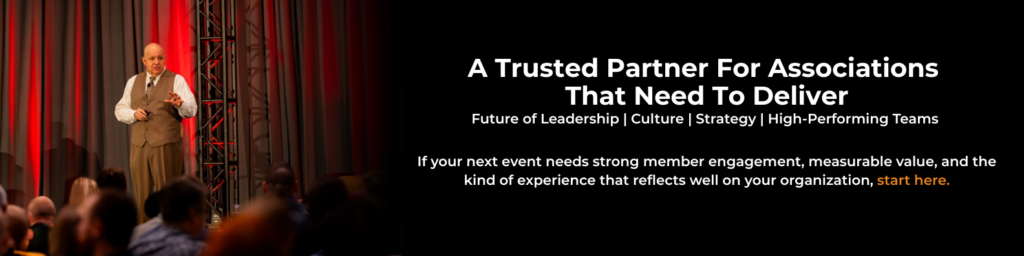
John Spence does not just walk on stage, deliver a keynote, and leave. He works with you as a trusted partner from the first planning conversation through the final follow-up.